
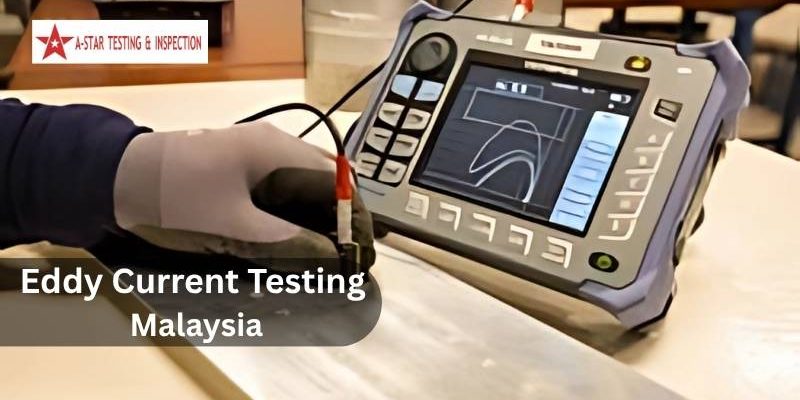
Integrity is an industrial concept where safety and reliability are crucial for critical components. In this case, Non-Destructive Testing ( NDT ) comes in as it is essential. An Eddy Current Testing (ECT) is one of the most powerful NDT methods that gunners widely use to identify defects in conductive materials without generating any waste during inspection.
When a company needs to identify defects within highly conductive materials wrapped in non-conductive faults, technicians employ Eddy Current Testing (ECT) to detect defects in the material. It is critical in sectors like oil & gas, aerospace, power generation, marine, and manufacturing, where features need to maintain component integrity that directly reflects on safety and efficiency in operations. Within the industrial inspection sector in Malaysia, the company continues to gain prominence due to the rising demand for high-level, competent, and trustworthy inspections to preserve the integrity of its resources and avoid the occurrence of expensive breakdowns.
What Is Eddy Current Testing (ECT)?
Eddy Current Testing (ECT) is the concept of electromagnetic induction. An alternating current energizes a coil and generates a primary magnetic field. When a conductive material is placed near this coil, the magnetic field induces loops of electric currents—known as eddy currents—within the material. Any flaw or discontinuity, such as a crack, corrosion, or thinning, disrupts the flow of these eddy currents. This disruption changes the impedance of the test coil. Inspectors then measure and analyze these impedance variations to identify and characterize the defects.
It is most effective when applied to conductive metals and has the benefit of being a non-destructive method of contact testing. It is also able to check a lot of metal at a fast rate and produce precise identification of flaws. ECT has unique advantages, as opposed to other types of NDT such as Ultrasonic Testing (UT), Penetrant Testing (PT), Magnetic Particle Testing (MT), especially when applied to the detection of surface cracks, corrosion, or imperfections in any weldments, again, frequently without the need to perform excessive pre-test preparation of the specified surface.
ECT applications in the Malaysian industries
The high level of precision and the adaptability of Eddy Current Testing have led to its use in many crucial industries in Malaysia. ECT is a very advantageous tool that inspectors depend on to achieve operational integrity and safety due to its capacity to identify many small defects within a short period. ECT is widely applied in industries in Malaysia in the following ways:
- Oil & Gas: Vital in inspection of pipelines and tubing, corrosion, pitting, and cracks in heat exchangers, process piping, storage tanks, etc, particularly in the vast network of Malaysia’s petroleum industry.
- Marine and Shipbuilding: Mandatory to detect corrosion in ship hulls and offshore platforms, and marine components, where the salt water causes greater damage.
- Aerospace: It is vital in the testing of important components of aircraft, the detection of fatigue cracks and material degradation in aircraft structure, engine, and landing gears, in ensuring the utmost high standards of safety.
- Power Generation: ECT is used to scan heat exchangers and condenser tubes of power plants by technicians. This will eliminate the delay in identifying defects that may lead to a loss of efficiency or a chain reaction that may cause the plant to malfunction.
- Manufacturing: Quality control of manufacturing of automotive parts or metal parts (quality of their parts, including quality of wheels, axles, and other parts made out of cast and/or forged metal).
Techniques of Eddy Current Testing Types
Eddy Current Testing has gone a step further and has come up with a variety of specific techniques to deal with well-defined inspection requirements and the types of materials to deal with.
- Conventional ECT: The simplest form, where surface and near-surface defects are detected with the use of a single coil. It is very useful and applied broadly when checking general flaws.
- Remote Field Testing (RFT): Suitable in cases where the conventional ECT has low penetration in inspecting ferromagnetic tubes. RFT has independent coils: exciter and receiver to determine the wall thinning and pitting.
- Pulsed Eddy Current (PEC): With this technique, technicians are used to quantifying the intensity of eddy current decay produced by a pulse electromagnetic field. It is particularly successful when visualizing corrosion under insulation (CUI) and thick materials examination-without having to remove the insulation.
- Array Eddy Current Testing (AECT): Applies multiple coils in an array to gain a faster and more thorough coverage of a large area and more complex geometries. This significantly increases the rate of inspection and obtaining of information.
Benefits of the use of ECT in Malaysia
Since it has unique benefits compared to conventional methods in inspection, Eddy Current Testing is beginning to assume prominence in industrial scenes in Malaysia. Such advantages help to create a better safety, efficiency, and cost-effectiveness of a wide range of operations.
- Great reaction to micro defects: ECT can identify small-level surface/near-surface defects, pits, and the degradation of materials, which other tests can not.
- Non-to-touch, non-destructive: The testing does not involve real contact with the test matter and can be used when dealing with sensitive surfaces or hot situations. It further implies that there is no requirement for couplants and other dangerous chemicals.
- No couplant or radiation: Unlike ultrasonic or radiography testing, couplants are unnecessary, and there are no radiation dangers; that is why ECT is easier and cleaner to the environment.
- High speed of preventive maintenance: ECT yields quick and reliable results, which are used to enable timely action to be taken regarding preventive maintenance, minimizing downtime, and maximizing its uptime.
The Use of a Checklist in Selecting a reputable Company to perform an ECT Test in Malaysia
It makes a difference to choose the proper ECT testing company in Malaysia to obtain proper results and the safety of your property. These are the main points to remember:
- Try certified ISO or DNV suppliers: ISO standards, including 9001, and approval of the suppliers by global governing agencies like DNV, can certify the supplier as observing international quality standards and best practices.
- Check the qualifications of the technicians: The people who conduct the inspections should be qualified according to a recognized standard (PCN Personnel Certification in Non-Destructive Testing or ASNT (American Society of Non-Destructive Testing) Level II or III). This ensures that they are experts and competent.
- Enquire about PAUT, RFT, and other high-end NDT facilities: A competent company must have a variety of high-end NDT technologies, such as Phased Array Ultrasonic Testing (PAUT), Remote Field Testing (RFT), Pulsed Eddy Current (PEC), and Array Eddy Current Testing (AECT) that meet the different inspection needs.
The reason to choose Astar Malaysia in ECT
We take pride in being a top provider of NDT services in Malaysia and in offering High-tech Eddy Current Testing services and solutions. Having years of experience and our focused approach towards excellence, our industrial quality and focus with years of expertise are taking care of making sure your industrial assets are intact with a high degree of safety.
We are also an ISO-certified and DNV-approved company, so you can always be sure that all services we offer exceed the highest international standards concerning inspections. Our group of very well-trained technicians with PCN and ASNT Level II/III certifications ensures the highest degree of mastery in all ECT techniques, including Conventional ECT, RFT, PEC, and AECT. We utilize state-of-the-art equipment and the latest technologies in delivering precise and excellent results.
Our product offering is diverse, with more than a dozen product lines that service a broad spectrum of industries in Malaysia, such as oil & gas, marine, aerospace, power generation, and manufacturing, as well as a solid local ground presence in all major Malaysian industrial hubs such as Kuala Lumpur, Johor, and Pengerang.
Malaysia Eddy Current Testing FAQs
Q1. Can all the metals be safe under ECT?
Ans: ECT is applicable only on conductive metals in which the inspectors can use it on. They fail to apply it to non-conducting substances, i.e. plastics, ceramics or composites.
Q2. What is the maximum retention duration of ECT data technicians must hold?
Ans: The time of an ECT inspection differs regarding the size and complexity of the part, the area that has to be checked, and the actual method involved. Generally, however, ECT is a rapid inspection procedure as compared to a combination of many other NDT methods.
Q3. Electroconvulsive therapy ECT price in Malaysia.
Ans: There are different variables that influence the price of the ECT in Malaysia, such as the nature of the component, its availability, the necessary ECT method, inspection time, and the milieu of the service. The service providers will always suggest that one get a personal quotation in order to get the right charges.
Q4. Can ECT reveal the flaws in paint or insulation?
Ans: Traditional ECT does not allow deep penetration of thick paints or insulation. Nevertheless, it is possible to utilize special methods such as Pulsed Eddy Current (PEC) that prove very efficient at finding corrosion under insulation relative to coating or insulation removal.
Q5. What kind of faults are products of ECT identifiable by the inspectors?
Ans: ECT does very well at finding various kinds and depths of cracks, surface or underneath, pitting, corrosion, material thinning, and material property variation, such as hardness or heat treatment.
Conclusion
It is no secret that Eddy Current Testing (ECT) has remained part of contemporary Non-Destructive Testing applications in Malaysia. It is a very valuable asset in guaranteeing the integrity of assets, safety, and optimum utilization of resources in many industries due to its effectiveness in the detection of cracks, corrosion, and other material flaws in conductive parts. The importance of ECT lies in its non-contact method, sensitivity, and the ability to do a quick inspection, which makes it an important element of the preventive maintenance scheme.
In matters regarding the protection of your investments in industry, there is no overestimation of hiring professional service providers in Malaysia. Astar Malaysia, due to its established experience, high-tech solutions, and qualified specialists, is one of the most reliable partners in providing viable and veracious Eddy Current Testing services that cater to industry requirements.
Related services in Malaysia
Frequently asked questions
What is eddy current testing (ECT)?
ECT uses electromagnetic induction to detect surface and near-surface flaws in conductive materials. A-Star Testing Malaysia uses conventional and array ECT for weld toe cracking, aircraft-style component inspection and non-magnetic tube inspection.
What can ECT detect that MPI can’t?
Cracks under coatings and paint (no need to strip), sub-surface defects in non-ferrous materials, and heat-treated component condition.
Is ECT suited to Malaysian offshore work?
Yes — ECT is portable, dry-couplant, and ideal for high-productivity weld screening on jackets, topsides and pipe supports.
Do you offer both conventional and array ECT?
Yes — plus PEC (pulsed eddy current) for CUI screening on insulated piping.