
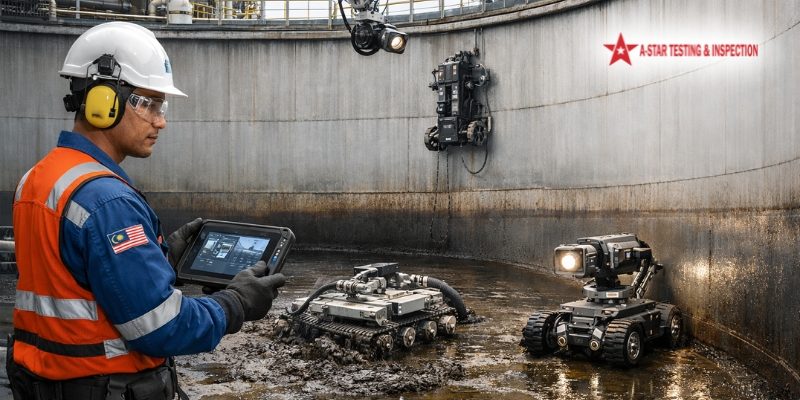
The storage infrastructure in the very center of the Malaysian industrial areas, which falls between the refineries of Melaka and the petrochemical centres in Terengganu, is a high-stakes game. Conventional approaches are usually time consuming and unsafe to human beings. Nonetheless, robotic cleaning and robotic inspection of storage tanks have emerged as the ultimate solution in verifying the integrity of modern assets.
With the help of on-site robotic cleaning and inspection, now companies are now able to implement a philosophy of No-Man-Entry. At A-Star Testing and Inspection (M) Sdn Bhd, we offer storage tank maintenance robotics that help eliminate the dangers of entering confined spaces, ensuring your facility is safe, compliant, and functional.
What Is Robotic Cleaning & Robotic Inspection for Storage Tanks?
This hybrid method incorporates automated sludge storage tank removal with high-accuracy NDT sensors. The third-party robotic inspection service prefers it to be used due to its objective digital information and the absence of subjectivity in the manual eye checks.
Core Service Capabilities:
- Modular robots, Industrial Robotic Cleaning Systems Malaysia: Our ATEX Zone 0 robots deal with a light oily residue to hard sludge of hydrocarbons.
- Robotic Tank Inspection Solutions: Using crawlers which are controlled remotely to survey tank floors and shells.
- Automation of the Maintenance of the Storage tanks: A comprehensive cleaning, extraction of waste, and structural check-up cycle.
Technical Guardrail: These services are specialized for internal tank environments and topside structures. We do not offer underwater or subsea inspection services.
Precision Technologies for Asset Integrity Verification
In order to offer the full inspection of the structural integrity using robots, we are using a combination of sophisticated sensors to map out each millimeter of your property.
1. Inspecting Tanks With Robots.
Before the commencement of the NDT, our robotically visual inspection of tanks involves the use of 4K, explosion-proof cameras to identify the level of sludge and internal heating coils, roof supports. This Quick Look stage defines these obstructions and provides the course of cleaning.
2. Ultrasonic & Corrosion Detection
To measure: Our robotic corrosion inspection is conducted at high-frequency UT sensors (B-Scan and C-Scan mapping) to measure:
- Remaining Useful Life (RUL): The calculation of the remaining life of the tank floor.
- Soil-Side Corrosion: It is necessary to detect thinning due to moisture under the tank bottom.
- Weld Integrity: Automated verification of the weld on the important shell-annular joint.
Why Choose Robotic Solutions in Malaysia?
The stringent DOSH and JKKP safety measures in Malaysia require stringent maintenance measures. Collaborating with an ISO-certified supplier of quality, such as A-Star, guarantees:
- Zero Downtime: Our in-service robotic system can inspect the interior floor of the tank and the product is still in the tank.
- API 653-Compliant accuracy: Regulatory-API and audit-ready results that are Class society and insurance company-ready.
- Risk mitigation: Man-entry elimination will destroy the main root cause of industrial tank accidents.
- Cost Efficiency: The clients are expected to achieve a 30 percent decrease on turnaround costs as they are not required to use scaffolding and a massive extent of degassing.
Frequently asked questions: Storage Tank Maintenance Robotics.
Q1. What is the advantage of on-site robotic cleaning and inspection?
Ans: It can be used to remove sludge to be stored in the tank and have a thickness map of the tank but not to empty the tank or deploy personnel into a potentially dangerous environment; reducing risk and cost greatly.
Q2. Is robotic inspection in line with the Malaysian JKKP standards?
Ans: Yes. The industrial robotic cleaning systems of our company in Malaysia are based on the international API 653 and ISO standards, which are acknowledged and promoted by the local safety authorities to minimize the risk in confined spaces.
Q3. Are the robots able to sense the presence of structural problems using thick sludge?
Ans: Preferably, non-destructive robotic cleaning should be done first by the robot. After the surface is prepared, our structural integrity robotic inspection is performed on the surface with UT sensors that can peep through the thin residual films to ensure an accurate metal thickness reading.
Q4. Does this involve sub-sea or underwater work?
Ans: No. These services are only restricted to the inside and outside of above-ground storage tanks (ASTs) and not to underwater or under sea services.
Conclusion: Safe, Smart, & Compliant
The new standard to Malaysian industries is robotic cleaning and robotic inspection of storage tanks. Going with the no-man-entry design, you minimize the risks of entering the confined space and simultaneously have high-quality asset integrity tests.
Robotic systems are much safer and more precise, and require no human intervention due to the fact that you can either use them to clean up sludge because of automated sludge removal or inspect the system because they comply with the API 653 requirements.
A-Star Testing & Inspection (M) Sdn Bhd is the place to contact today and obtain a prompt quote on your next robotic tank project.
Related services in Malaysia
Frequently asked questions
Why use robotic cleaning + inspection?
Robotic tank cleaning removes sludge and inspects the floor without man-entry — cutting confined-space risk, shortening shutdowns and enabling near-real-time API 653 data collection.
What does the robot do?
A tethered robot enters through a manway, degases and pumps out sludge, then scans the floor with UT and CCTV. Cleaning + inspection happen in a single mobilisation.
Do you follow API 653 protocols?
Yes — data output includes MFL screening, UT prove-up thickness, tank floor mapping and settlement survey aligned to API 653.
What tanks in Malaysia is this suited for?
Refinery product tanks, crude storage, LNG condensate, chemical storage, and terminal tanks — anywhere man-entry cleaning is slow or dangerous.