
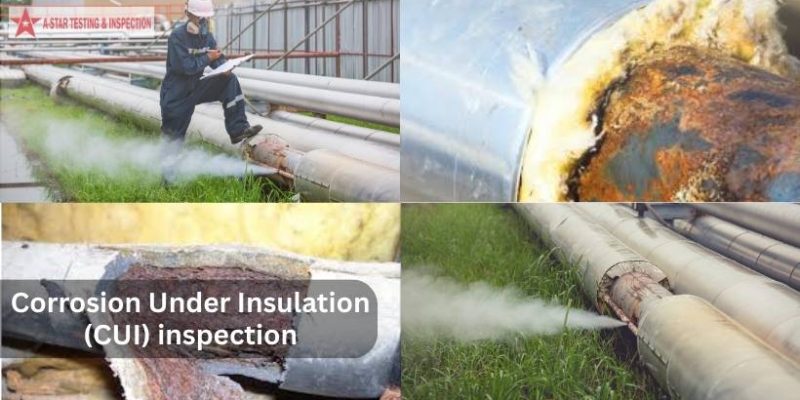
Corrosion Under Insulation (CUI) is among the most prevalent and costly types of damage to industrial equipment encountered in the oil and gas, petrochemical, marine, and power generation sectors. It is an opacely corrosive condition on pipelines, vessels, and equipment that occurs when moisture or contaminants are present in the protective insulation. When not detected early, this form of corrosion may culminate in leakages, faulty equipment, unexpected shutdowns, and hazards. Corrosion Under Insulation (CUI) inspection is used to safeguard pipelines, vessels, and other industrial properties using A-Star Testing highly advanced NDT solutions.
Corrosion Under Insulation (CUI) inspection is crucial to defend critical infrastructures. How industries can identify the first signs of wear and tear, reduce downtime, and extend the life of their assets by utilizing a set of high-precision non-destructive testing (NDT) equipment and gaining a deeper understanding of the profession.
What is the Corrosion Under Insulation (CUI)?
Corrosion Under Insulation is defined as the local destruction of metal by thermal insulation. Water, chemicals, or atmospheric contaminants, when leaked through insulation, are retained against the metal surface. This creates a corrosive atmosphere that accelerates degradation, particularly in structures made of carbon steel and stainless steel.
The insulation abrasion can make CUI hard to identify, as it is a hidden risk, as the damage coats the insulation. However, the corrosion can be in its acute form by the time one notices symptoms, like insulation damage or leaks.
Typically affected components are:
- Process piping and pipeline.
- Pressure and storage tanks.
- Offshore buildings and platforms.
- Petrochemical plants, refineries.
CUI can impact structural integrity, which can be costly and hazardous to repair and operate until it is successfully addressed. That is the reason why Corrosion Under Insulation (CUI) inspection plays a vital role in the management of asset integrity over an extended period of time.
The Reason CUI is an important issue in industrial procedures
CUI is very dangerous in many industries because it is unnoticeable and may have dire consequences. The main concerns include:
- Safety hazards: These may include corrosion leading to weakening of equipment, hence leakages, fire or explosion.
- Unplanned downtime: When something unexpected happens to equipment, this aspect of downtime is implemented by halting production, resulting in losses.
- Maintenance problems: Diagnosis of CUI is difficult without special examination procedures.
- Asset Degradation: Pipelines, Vessels, and Structures. The uncontrolled form of degradation is depleted more quickly.
- Compliance concerns: Industries are required to comply with safety regulations and international inspection standards.
The oil and gas, petrochemical, marine, and power generation industries are the most susceptible to CUI due to adverse environmental conditions, varying temperatures, and moisture, which can cause corrosion. CUI inspection at set intervals will result in safer operations and effective maintenance.
Corrosion Under Insulation (CUI) Inspection Methods
1. Visual Inspection
The procedure is performed when insulation is being removed or during maintenance, and is used to identify a rust stain, wet insulation, or surface corrosion. It is neither expensive nor time-consuming, and it can only be applied where the insulation is exposed.
2. Ultrasonic Thickness Measurement (UTM)
UTM is a sound wave tool that is used to gauge the wall thickness and measure metal loss through insulation. It is extensively applied to pipelines and vessels and can be used to provide good results to track the trends of corrosion over time.
3. Phased Array Ultrasonic Testing (PAUT)
PAUT generates high-resolution cross-sectional and 3D images, detecting cracks, pitting, and thinning. It must be applied whenever dealing with very sensitive assets that require a very high degree of checking and structural integrity checks.
4. Eddy Current Testing (ECT)
ECT relies on electromagnetic induction to detect corrosion on surfaces and in the near-surface region. Works well on stainless steel and non-ferrous materials; it can be used to detect the presence of a stain without doing mass insulation removal.
5. Digital Radiography (DR)
DR applies to provide live-time high-resolution images of insulated corrosion and defects. It reduces downtime, improves the inspection process, and is also widely used on pipelines, welds, and pressure equipment.
6. Acoustic Emission (AE) Testing
AE testing is used to detect active corrosion or crack stress waves. It works very well with large tanks and ships, and provides continuous structural health monitoring without a lot of insulation removal.
CUI Inspection Benefits the Industry
A planned Corrosion Under Insulation (CUI) inspection program provides numerous benefits to any industry working in severe and challenging conditions:
- Cost Savings: It will prevent failures through early detection, emergency maintenance optimization, and overall costs will be reduced.
- Safety Assurance: In most cases, checks for leakage, fire, and accidents, which may harm the workforce and damage the plant, will be reduced.
- One method of extending the life of pipelines, Vessels, and offshore structures is the Long Asset Lifespan Ongoing, which does not affect the capacity of these structures.
- Regulations: ASME, API, and DNV will exempt them from costly and painful inspections, allowing them to escape heavy fines.
- Operation Efficiency: Predictive inspection of the operation can be used to eliminate downtime and help adapt maintenance to planned shutdowns.
- Environmental Protection: Leaks and emissions are avoided, minimizing ecological impact in sensitive industrial areas.
Why A-Star Testing & Inspection for CUI Inspection?
A-Star Testing & Inspection is a leading provider of CUI inspection services, offering high-quality solutions in Malaysia and other parts of the world. The company has decades of experience in non-destructive testing, guaranteeing accurate results, minimal downtime, and optimal safety.
Among the reasons to prefer A-Star Testing & Inspection, one can mention:
- An experienced workforce of 300 or more qualified personnel in the field of advanced NDT techniques.
- Successful practice in offshore, petrochemical, marine, and industrial undertakings.
- State-of-the-art inspection technologies, such as PAUT, UTM, DR, and AE.
- ASME, DNV, and international standards (iso 9001: 2015 certification).
- Ability to perform the inspections through the rope access methodology that is cost-efficient and productive.
Being a leading technical company with a regional Corrosion Under Insulation inspection, A-Star Testing & Inspection is considered to be reliable and precise in providing quality Corrosion Under Insulation inspection.
Frequently Asked Questions (FAQ)
Q1 What is the cause of corrosion under insulation (CUI)?
Ans: CUI occurs when water or other contaminants enter the insulation, creating a corrosive environment on the hidden metallic surface.
Q2: With what frequency are CUI inspections to be undertaken?
Ans: The nature of the environment and asset determines the frequency of inspection, but most industries will examine their assets every 2-5 years.
Q3: Which of the industries are at the highest risk of CUI?
Ans: The industries most exposed include oil and gas, petrochemical, power generation, and marine industries because of the harsh conditions.
Q4: How do you think CUI should be inspected best?
Ans: Ultrasonic testing coupled with phased array ultrasonic testing and the use of digital radiography gives the best results.
Q5:Is it possible to carry out CUI inspection without removing insulation?
Ans: Yes, more advanced methods, such as PAUT and digital radiography, do not require the removal of the insulation to be inspected.
Conclusion
Corrosion Under Insulation (CUI) is a severe and potentially hazardous issue affecting industrial plants. Lack of adequate monitoring can result in serious damage, unexpected downtime, and loss of safety. High-tech Corrosion Under Insulation (CUI) inspection techniques can help industries identify early corrosion, offer compliance, and extend the life of their assets.
To provide a complete package of CUI inspection services, A-Star Testing & Inspection integrates knowledge and skills in the field of technology, its fraternity of certified personnel, and advanced technology. Proactive inspection is crucial to the success of industries that want to secure their assets, as well as those that have guaranteed operation.
Related services in Malaysia
Frequently asked questions
What causes corrosion under insulation (CUI)?
Moisture trapped between insulation and pipe/vessel walls creates hidden corrosion — especially between 60–175 °C. Left unfound, CUI is a leading cause of piping leaks in Malaysian refineries and petrochemical plants.
Which techniques do you use to detect CUI?
A-Star Testing Malaysia uses pulsed eddy current (PEC), profile radiography, real-time radiography and guided-wave UT — matched to insulation type, pipe geometry and access. Non-intrusive so insulation removal is minimised.
Do we have to remove the insulation?
No. Our CUI programmes are designed to keep insulation in place for the majority of scans, cutting downtime and cost. Only confirmed hotspots are stripped for direct measurement.
How is the CUI report delivered?
You receive a coded map of every inspected section, severity ranking, photo evidence, and a recommended repair or re-inspection interval per RBI (Risk-Based Inspection) principles.