
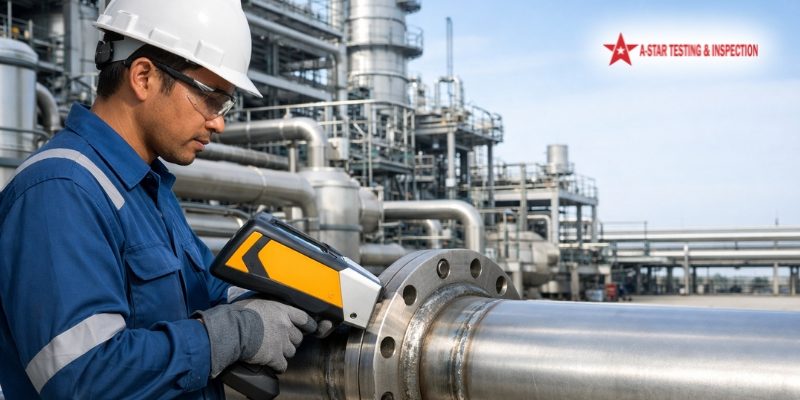
The inappropriateness of material in industrial projects may result in disastrous failures, environmental catastrophes, and huge litigation expenses. Material integrity is not only a choice in the fast-growing industry of Malaysia, whether it is the refineries of Pengerang or the semiconductor-driven centres of Penang; it is a requirement that is mandatory by regulation.
Positive Material Identification (PMI) services Malaysia provide the ultimate protection against material mix-ups. PMI testing services in Malaysia offer instant and non-destructive chemical analysis of metal alloys to guarantee that the 316 Stainless Steel that you paid your money for is what has been installed. The technological aspects of PMI, compliance issues, and industrial applications of PMI in the Malaysian market are discussed in this guide.
What is Positive Material Identification (PMI)?
Positive Material Identification (PMI) is a special non-destructive (NDT) test that determines the chemical composition of metals and alloys. Since it was introduced in 2019, compared to the traditional lab testing that may require cutting a sample, PMI is conducted on-site and gives a quantitative analysis of elements such as Chromium, Nickel, Molybdenum, and Carbon.
Essentially, the positive material identification testing is a test that makes sure that the metallic parts of your system meet the appropriate standard and specifications. It could be just a tiny weld fill or a huge pressure vessel; PMI identifies the identity of the metal by metal composition analysis.
Why PMI Testing is Critical in Industrial Projects
In Malaysia, where the Department of Occupational Safety and Health (DOSH) has become more vigilant of mechanical systems in 2026, PMI has been the first line of defence against:
- Avoiding Material Mix-ups: In large-scale construction, it is all too simple to have a low-grade carbon steel bolt accidentally replaced by a high-strength alloy counterpart.
- Assuring Compliance: Adherence to high international standards such as API 578 ( Material Verification Program ) and ASME Section VIII.
- Avoiding Safety Risks: Preventing sulfidic or other failures in using the incorrect alloy under high-pressure or high-temperature conditions.
- Industrial Quality Assurance: Having a written record of the material traceability inspection to be given to the auditors and insurers.
How PMI Testing Works
The two major technologies used in modern PMI testing services in Malaysia are to offer instant material analysis:
- X-Ray Fluorescence (XRF): This is achieved by striking the metal with X-rays, which causes the atoms to fluoresce and give out secondary X-rays. The individual elements produce their own signature, which is detected by the device in a few seconds to identify the grade of alloy.
- Optical Emission Spectroscopy (OES): In this, a small portion of the metal surface is evaporated using an electrical spark. The light released by the spark is studied to give a very precise chemical disintegration, such as light elements, such as Carbon.
Types of PMI Testing Methods
It is critical to select the correct approach to be accurate and compliant.
XRF (X-Ray Fluorescence)
The workhorse of the industry is the handheld PMI analyser.
- Advantages: It is totally non-destructive, very portable, and the results are obtained within less than 30 seconds.
- Best Use: Checking alloy grades (e.g., 304 vs. 316 stainless steel).
- Keywords: XRF PMI testing, handheld PMI analyser.
OES (Optical Emission Spectroscopy)
OES is applied to situations where the greatest degree of accuracy is needed in chemical composition testing.
- Advantages: It is the only sure way of identifying light elements such as Carbon, Phosphorus, and Sulfur, which are portable.
- Best Applications: Calculations of Carbon equivalency (CE) and checking L-grade stainless steels.
- Keywords: OES metal analysis, high precision PMI.
Applications of PMI Services in Malaysia
The special industrial mix of Malaysia demands the specific services of PMI Malaysia:
- Oil and Gas Pipelines: Pivotal in pipeline material checking in PETRONAS-led projects to avoid leakage through corrosion.
- Refineries (Pengerang/Melaka): Important to test high-alloy piping circuits during turnarounds.
- Semiconductor Fabs (Penang/Kulim): It is important to ensure that the high-purity process utility lines (gas/water) are made of the proper high-grade stainless steel to avoid contamination.
- Welding: Welding Provision of fabrication quality control in Malaysia by checking that the filler material used in welding is the same as the parent metal.
Benefits of PMI Services
There is a tangible ROI in investing in professional QA/QC inspection services:
- Check Material Accuracy: Rid yourself of the possibility of bad materials getting into your supply chain.
- Improve Safety: radically lower the risk of mechanical failure that is caused by improper alloying.
- Prevent Expensive Rework: It is much more economical to test a valve prior to installation than to replace a valve after the plant has become live.
- Compliance Inspection Services: Be audit-ready to pass DOSH and international audits with certified digital reports.
Common Issues Detected by PMI Testing
A professional PMI service provider in Malaysia often detects:
- Material Mix-ups: A consignment of “Inconel”, which is a cheaper nickel alloy.
- Incorrect Alloys: Standard stainless steel is being used where “Low Carbon” (316L) was specified.
- Poor Materials: Scrap-heavy metals with traces of elements (such as Copper or Tin) that may result in cracking during welding.
- Keywords: alloy verification test, material grade verification.
Choosing the Right PMI Service Provider in Malaysia
All industrial inspection services in Malaysia are not the same. In choosing a provider, check:
- Certification / Experience: Have the technicians been trained in both XRF and OES? Do they have NDT Level II certifications?
- Modern Technology: Are there handheld PMI analyzers of the newest 2026-gen with cloud reports?
- Experience in the Industry: Do they have a history of dealing with Malaysian-specific regulations and DOSH requirements?
Use skilled personnel to verify the materials accurately.
Cost of PMI Services in Malaysia
The cost of PMI testing in Malaysia is normally determined by:
- Project Size: Will it be a 10-point check on one skid or a 5,000-point audit on a refinery?
- Testing Method: OES tends to be more costly as it requires the use of argon gas and larger surface preparation.
- Location: On-site services in remote places (such as offshore Sabah/Sarawak) will mean higher mobilisation fees.
Hint: PMI is not a cost to consider but rather insurance. A single failure of alloys in a high-pressure line is very expensive, which is much more than the lifetime of PMI testing services in Malaysia.
Why PMI is Essential for Compliance and Safety
As 2026 unfolds, the Malaysian industrial sector is taking a turn to a Zero-Trust material policy. Safety and reliability tests are now considered more important by regulatory bodies such as the Department of Standards Malaysia (JSM) and the DOSH. It is no longer regarded as an optional extra as electronic PMI reports have become the heart of a modern Material Verification Program (MVP).
Conclusion: Ensure Material Accuracy with PMI Services
Positive Material Identification (PMI) services Malaysia provide you with the certainty that you require in a world where global supply chains may be unpredictable. You save your plant, your workers, and your bottom line when you check all the bolts, pipes, and welds. Make sure your project is constructed on the proper basis with professionalPMI testing services in Malaysia.
Get professional PMI services in Malaysia and make sure that the material is intact.
Frequently Asked Questions (FAQ)
Q1. Is PMI non-destructive indeed?
Ans: XRF PMI testing is 100% non-destructive. Nevertheless, OES metal analysis is semi-destructive in the sense that it produces a small burn mark on the surface of a spark that is a few millimeters in diameter.
Q2. Is Carbon detected by XRF?
Ans: No. XRF technology is not reliable in detecting light elements such as carbon, which can be detected by handheld XRF. In case your project needs Carbon content verification or Carbon Equivalency (CE), then OES or LIBS (Laser-Induced Breakdown Spectroscopy) must be used.
Q3. Are PMI pressure vessels required by DOSH?
Ans: Although this is not explicitly required on all vessels, DOSH safety and reliability testing requirements consider the correct verification of equipment ratings and equipment material selection with a high degree of importance, and thus PMI is a common standard practice in industries to be approved.
Q4.What is the rate of getting the results?
Ans: In the case of XRF, the outputs are real-time on the monitor. A formal digital report by professional PMI service providers in Malaysia is usually issued within 24 hours post-site visit.
Related services in Malaysia
Frequently asked questions
What is PMI (Positive Material Identification)?
PMI verifies the actual alloy grade of metals in-place using X-Ray Fluorescence (XRF) or Optical Emission Spectroscopy (OES). A-Star Testing Malaysia uses handheld XRF for rapid, non-destructive alloy verification on piping, valves, welds and components.
Why is PMI important in Malaysian refineries and petrochemical plants?
Wrong-material substitution is a documented cause of piping failures in high-temperature and sour services. PMI catches material mix-ups before commissioning or during shutdown inspections — cheap insurance against catastrophic failure.
Which materials can A-Star Testing PMI identify?
All common process alloys — carbon steels, chrome-moly (P5, P9, P11, P22, P91), 300/400-series stainless, duplex, super-duplex, nickel alloys (Inconel, Monel, Hastelloy), titanium and copper alloys.
Do you supply certified PMI reports?
Yes. Every job in Malaysia is delivered with a full PMI report — alloy grade, chemical composition, tag reference, location photo, and Level II PMI technician sign-off — accepted by all major EPCs and operators.