
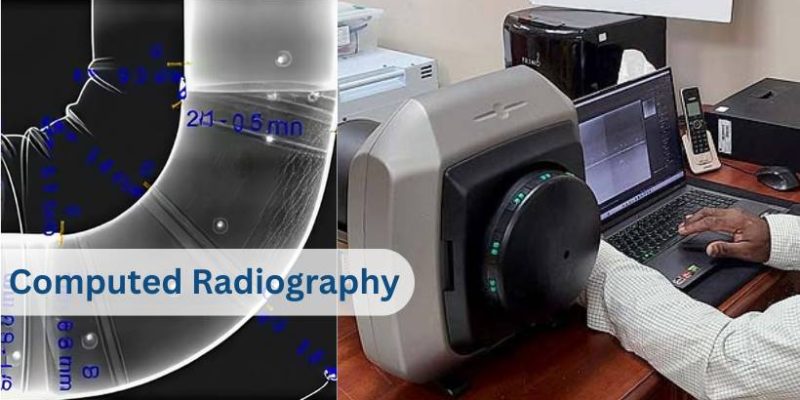
What is the best way to identify internal defects in critical infrastructure without destroying equipment and taking days to process chemical films? Industrial radiography has been bound to the decades-old, slow, cumbersome method of film development. Computed radiography service has now changed the face of non-destructive testing (NDT), providing high-resolution imaging instantly and high-capacity diagnostic means in a digital form.
Computed radiography inspection is the new gold standard in refinery inspection services, structural engineering, and power generation inspection and maintenance by substituting traditional film with erasable, reusable imaging plates. This guide will discuss the mechanics of CR, its benefits, and the ROI of selecting CR as your next inspection project.
What is Computed Radiography?
Computed Radiography (CR) is a digital radiography technique that employs phosphor-based imaging plates (IPs) rather than the conventional X-ray film. Exposing these plates to X-rays or gamma rays leaves a latent image of the object in the plates. A laser-based digitizer scans this plate, and the energy stored is emitted as light and is converted into a digital file.
CR is a dry and digital process, unlike the legacy radiographic testing services, which used darkrooms and chemical baths. This renders digital radiography services much cleaner, quicker, and more adaptable in the field.
How Computed Radiography Works
CR is efficient with a three-step process:
- X-Ray Exposure: This consists of the imaging plate being positioned in the background of the part being examined. The area is then exposed to radiation.
- Plate Scanning: The plate is scanned on a CR scanner. The laser (high-resolution internal image) is captured by the phosphor.
- Digital Image Processing: The program can enable the technician to optimise the contrast, zoom in on a particular area, and control the brightness to uncover the defects that could have been concealed in traditional film.
This allows the digital X-ray inspection to be the most precise way of detecting the sub-surface density variation in welds and castings.
Advantages of Computed Radiography Over Traditional Methods
Convenience is not the only factor that has led to the transition to CR. It offers a high technical foundation:
- Quicker Turnaround: Film development is not required. It is possible to upload, analyse, and share digital files in real-time.
- Sharper Image Quality: High-resolution radiography has a higher dynamic range–you can clearly see details in both thin and thick wall sections with a single exposure.
- Green: Removes the employment of poisonous chemicals and the logistical nightmare of getting rid of dangerous processing fluids.
- Reproducible: It is possible to store digital files indefinitely, back up, and store archives that can be compared historically during the audits of asset integrity management.
Applications of Computed Radiography in Industries
CR is the workhorse of heavy industry, especially where there can be no compromise on precision:
- Pipeline Weld Inspection: Detection of gas pockets, absence of fusion or slag inclusions in high-pressure oil and gas lines.
- Pressure Vessel Inspection: It is to verify the integrity of critical vessels, which are subjected to extreme thermal and mechanical stress.
- Structural Weld Inspection: Inspection of the quality of the welds in large-scale bridge and high-rise construction.
- Refinery Inspection Services: Analysis of internal corrosion, wall thinning in complicated pipe systems.
Computed Radiography vs. Digital Radiography (DR)
The terms are commonly used interchangeably, but technically, there is a difference:
- Computed Radiography (CR): This has a flexible imaging plate, which needs to be scanned following exposure. It is very portable and good when working in the field on pipes and odd shapes.
- Digital Radiography (DR): Refers to a flat-panel detector that is characterised by showing an image virtually right after the fact, but not through scanning.
Whereas DR is quicker, CR imaging plates are far thinner and more pliable, and they can be wrapped around pipes or inserted into narrow spaces that a rigid DR panel could never fit into.
Defects Detected Using Computed Radiography
CR is used by a professional NDT inspection company to seek the “silent killers” of mechanical systems:
- Cracks: Detection of fatigue or stress fractures before they spread.
- Porosity: This is used to identify gas bubbles that are stuck in welds.
- Corrosion: Mapping of thinning and pitting of internal walls.
- Inclusions: Spotting slag or tungsten that was left behind during the welding process.
Benefits of Hiring Professional Computed Radiography Services
What is the rationale for outsourcing to a certified computed radiography service provider?
- Expert Analysis: NDT Level II/III technicians have the “trained eye” to interpret digital artefacts.
- Precise Results: Scanners of international standards (ISO/ASTM).
- Compliance Assurance: Delivery of the certification documentation envisaged by the local health and safety authorities.
Select the professionals who are certified to be reliable during inspection.
Cost of Computed Radiography Services
The radiography inspection cost is a factor of three key variables:
- Project Scope: The exposures or the length of the pipeline/vessel.
- Complexity of Access: The duration of the time needed to install the radiation area and transportation devices at the inspection point.
- Equipment & Complexity: Does it require regular isotope sources or, on heavier steel walls, high-energy X-ray tubes?
Tips: Do not compromise the accuracy in favour of a lower quote. An inadequate inspection may result in a multi-million dollar failure. Consider reliability and the track record of the provider of the inspections.
Why Computed Radiography is Essential for Asset Integrity
In the new age, industrial inspection services have become more about prediction, not only detection. CR enables the monitoring of the thinning of the walls (over the years). The engineers are able to determine the rate of corrosion by superimposing digital images that are two years apart, which means that when they reach the end of their useful life, the engineers can replace them before they break down. Effective asset integrity management comes down to this data-based approach.
Conclusion: Upgrade Your Inspection with Digital Radiography
Computed Radiography service is not an upgrade; it is a change of your maintenance strategy. CR offers high-resolution, digital-ready data, thus speeding up the process of decision making, detecting defects more effectively, and reducing the environmental footprint. Among high-risk industries, it is the strongest tool that can be used by companies to guarantee the safety and life of key assets.
Be sure to have accurate defect detection through professional computed radiography today.
Frequently Asked Questions (FAQ)
Q1. Is Computed Radiography (CR) Non-Destructive?
Ans: Yes. Computer radiography inspection is one of the fundamental areas of non-destructive testing (NDT). It allows studying the inner structure of a component in detail without any physical or chemical harm to the material.
Q2. Is CR able to be used on high-temperature pipes?
Ans: Yes, but with care. CR imaging plates are phosphor-based and temperature sensitive. In case the pipe is excessively hot, then the image may either be erased or deteriorated. Professional providers use special thermal shielding or “cool-down” times to handle this.
Q3. What is the comparison between CR and Ultrasonic Testing (UT)?
Ans: CR gives a visual image that is permanent and can be looked at by third parties, unlike UT, which gives real-time data in the form of an echo. CR and UT are applied as complementary techniques in most cases in industrial applications to ensure the most comprehensive inspection.
Q4. What is the duration of the digital files?
Ans: As opposed to the old-fashioned film, which may degrade, rot, or get scratched with time, digital files may be stored in the cloud with redundant backups, so they will last as long as the life of the asset, 2030.
Related services in Malaysia
Frequently asked questions
What is computed radiography (CR)?
CR replaces X-ray film with reusable phosphor imaging plates that are scanned to digital images. A-Star Testing Malaysia uses CR to deliver film-quality NDT weld inspection at up to 5× the throughput.
Where is CR commonly used in Malaysia?
Refinery and petrochemical piping fabrication, offshore construction, storage-tank welds, pressure-vessel manufacture and pipeline girth welds.
Is CR accepted under ASME and international codes?
Yes — ASME Section V Article 2, ISO 17636-2, and ASTM E2007/E2033. A-Star Testing Malaysia’s CR system meets sensitivity classes B and A for weld inspection.
How do I request CR services from A-Star Testing?
Send drawings and scope through our contact form. We quote within one working day and mobilise anywhere in Malaysia.