
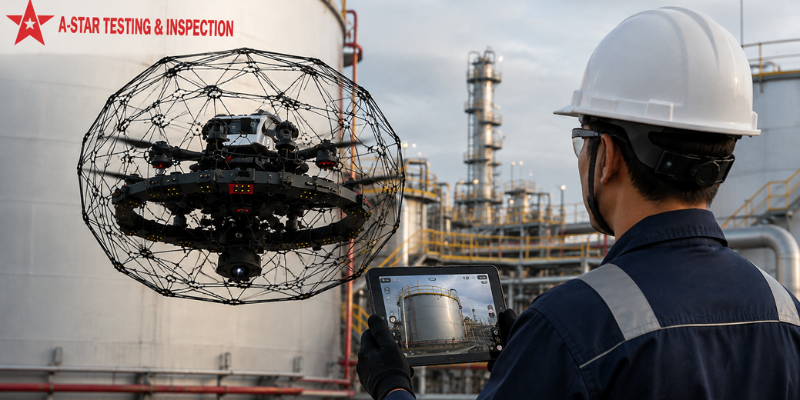
The use of drone technology to conduct inspections on structures, equipment, and remote areas is becoming increasingly popular with industrial facilities across Malaysia. Offshore platforms and storage tanks, factories, towers, and much of the infrastructure can be surveyed using unmanned aerial vehicles (UAVs) to capture comprehensive visual data, without requiring workers to travel to potentially risky areas.
Drone services in Malaysia are an effective option to enhance efficiency in inspection, gather precise site data, and facilitate asset integrity programs with companies that handle critical assets. UAV technology can be used to supplement traditional inspection methods in various industries when it is used in conjunction with skilled inspection officers and an appropriate analysis of the data obtained.
What Are Industrial Drone Inspection Services?
Industrial drone inspection is the process of inspecting structures and equipment by air with the help of remotely operated or autonomous UAVs with cameras and special sensors.
Contrary to traditional methods of inspection, which might demand scaffolding, cranes, rope access, or work platforms, drones can be used to take images and videos of hard-to-reach areas with minimal physical interference.
High-resolution optical cameras, thermal imaging, zoom cameras, and other specific payloads can be added to UAVs depending on the inspection purpose.
Why Are Drone Inspections Important for Industry?
Difficult, expensive, or dangerous areas may be found in places that inspection teams can avoid accessing, or that could be difficult to access in industrial assets. Some of them include tall structures, flare stacks, roofs, bridges, offshore structures, and large storage facilities.
Drones Inspection services in Malaysia are capable of assisting organizations to gather visual data and minimize unnecessary exposure to working-at-height hazards.
Other potential benefits include:
- Rapidly scan large regions.
- Less need to use scaffolding in appropriate applications.
- Possibility to reach hard-to-reach places.
- High-resolution photographic documentation
- Improved inspection planning
- Less interference with some functions.
- Improved historical audit of assets.
Drones should not automatically be used in place of more traditional NDT and engineering inspection methods where detailed inspection of materials or structure is necessary, but must supplement it.
Applications of Industrial Drone Inspection in Malaysia
Oil and Gas Facilities
Oil and gas plants have many high and inaccessible properties. Industrial Drone Inspection Malaysia will be able to assist in visual inspection of the flare stacks, pipelines, structural members, roofs, platforms, and other locations where aerial inspection is feasible.
Images taken can assist the inspector to detect visible corrosion, coating corrosion, deformation, cracks, loose parts, and other surface conditions that might need additional investigation.
Offshore and Marine Assets
The conditions of offshore facilities demand a difficult environment, such as exposure to saltwater, wind, and humidity. The UAVs can also offer an aerial view of platform structures, helidecks, cranes, flare systems, and other available parts.
Drones can also aid in maintenance planning by giving up-to-date visual data without necessarily requiring a large scale deployment of access equipment in the case of offshore operators.
Storage Tanks and Industrial Structures
UAVs can be used to inspect large tanks and warehouses, towers, and industrial buildings at many different angles. With the high-resolution imagery, inspection teams can record the processes on the exterior surface and specify areas that need additional scrutiny.
Power and Utility Infrastructure
The aerial surveys can be utilized by power plants and utility operators on the selected structures, roofs, and assets related to transmission, cooling infrastructure, and other elevated parts.
How UAV Technology Supports Asset Integrity
Drones Asset Inspection Malaysia is becoming more and more applicable to organizations with long-term inspection and maintenance programs.
A drone will be able to capture repeatable images which can be compared to previous inspection records. This provides a visual history of an asset and can assist teams to determine changes over time.
As an illustration, periodic surveys can record the alterations in the coating condition, corrosion appearance, structural entities, vegetation encroachment, or other observable conditions.
Nevertheless, not all types of defects can be identified by drone imagery. Internal defects, loss of material thickness, weld breaks, or other structural circumstances of the structure can necessitate NDTs like ultrasonic testing, radiography, or magnetic particle testing, or other suitable inspection techniques.
What Equipment Is Used?
Modern UAV inspection systems may utilize various payloads based on the project.
General visual inspection and documentation are often done with high-resolution RGB cameras. The inspection of remote parts can be done with the help of optical zoom cameras so that the drone will not have to go very far to inspect something.
One can also monitor temperature changes using thermal cameras that can be later developed, and special sensors can provide assistance in surveying and mapping.
The equipment choice must always be on the basis of the asset, inspection purpose, environment conditions, resolution necessary, as well as safety requirements.
Safety and Regulatory Considerations
Every commercial UAV operation entails safety as an essential element. The operator is expected to evaluate the flight setting, weather, buildings in the vicinity, human beings, equipment, and hazards before an inspection.
There are also Malaysian aviation and site-specific requirements that have to be followed by operators. More rules may be applicable in the industry facilities, which will be related to restricted areas, hazardous sites, electrical equipment, offshore, and other activities simultaneously
An inspection company employing drones is expected to integrate skilled drone operations with adequate risk management, flight planning, data management, and site safety measures.
Drone Inspection vs. Conventional Inspection
Drones have great benefits in visual surveys, although not all inspections should be substituted by drone technology.
UAVs come in handy especially where the goal is to capture aerial images, record surface conditions, map expansive areas, or investigate areas that cannot easily be reached.
When there is a defect that needs extensive inspection, the drone data can assist the inspectors to determine where they need to employ more measures. A more efficient approach to the inspection would be a combination of UAV surveys and relevant NDT methods.
Frequently Asked Questions
Q1. What are drone inspection services used for?
Ans: Drone inspection services are employed to inspect high, big, or inaccessible buildings and assets visually. These are used in industrial facilities, offshore structures, tanks, towers, roofs, and infrastructure.
Q2. Is the use of drones in inspections of oil and gas appropriate?
Ans: Yes, UAVs can facilitate the chosen visual inspection tasks in oil and gas facilities. But the drone system, operating procedure, equipment classification, and site controls need to be suitable for the particular environment.
Q3. Are drones able to sense corrosion?
Ans: With appropriate imaging, drones are able to detect observable surface corrosions, coating damage, and deterioration. By verifying the corrosion depth or remaining thickness of the material, the standard NDT methods are usually used.
Q4. What is UAV as compared to drone inspection?
Ans: UAV is an abbreviation of Unmanned Aerial Vehicle. “Drone” is the commonly used term for these remotely operated or autonomous aircraft. Both terms are commonly used in the same technology in industrial inspection.
Q5. What can drone inspections do to enhance asset integrity?
Ans: UAV surveys are capable of providing up-to-date visual data, assisting in the detection of places that need more attention, assisting in planning maintenance, and generating repeatable documentation to track apparent changes over time.
Conclusion
UAV technology is transforming the method of visual inspection, surveying, and monitoring of assets in industries. By giving organizations quick access to the air and allowing documentation of hard-to-reach places in detail, Aerial Inspection Services Malaysia and drone services in Malaysia can assist organizations in their evaluation of places that are harder to reach, as well as aid in a more effective and safer planning of inspections.