
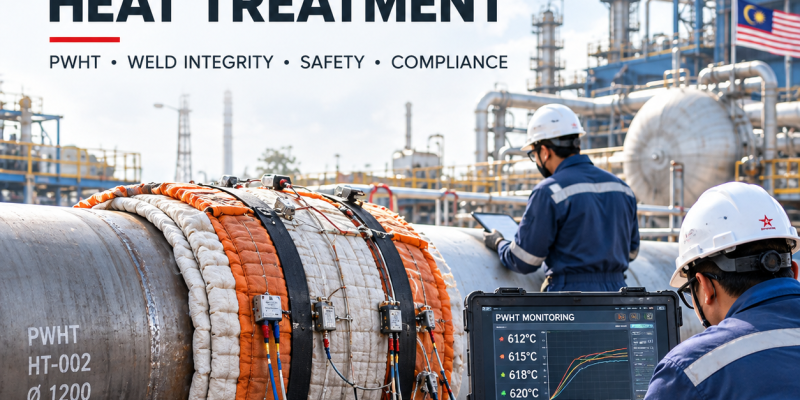
Welding is an essential component of construction and fabrication in oil and gas, petrochemical, power generation, marine, and heavy engineering industries. But it is not always ready to service a component once a weld is completed. Residual stresses and altered microstructure of the material may result during welding, especially in the thicker parts and those that are subjected to harsh operating environments.
Herein lies the significance of Post Weld Heat Treatment in Malaysia. PWHT is a regulated process of heating and cooling that follows welding to minimize residual stresses, enhance desired material qualities, and facilitate the demanded quality of welds and service performance.
In the case of critical industrial equipment, appropriate heat treatment may constitute a significant element of the integrity of the weld, quality control, and conformance.
What Is Post Weld Heat Treatment?
Post Weld Heat Treatment (PWHT) is a controlled thermal procedure that occurs after welding. The welded part is heated to a certain temperature, maintained for a certain length of time, and finally cooled following a sanctioned process.
The specific temperature, heating rate, soaking duration, and cooling process varies depending on the grade of material, thickness, welding process, component shape, and relevant codes or project specifications.
PWHT is not a process of one size fits all. The appropriate process has to be created based on the engineering needs of the component and the standard being applied.
Why Is PWHT Important for Welded Components?
The localized heating and cooling are a result of the welding process. This may leave behind any form of residual stresses around the weld and heat-affected areas. These stresses may also aid in distortion, cracking, or even poor service performance in some materials and service conditions.
Weld stress relieving assists in alleviating these residual stresses by controlled heating and cooling.
PWHT can also be used to enhance ductility and minimize the risk of some hardness or microstructural conditions depending on material and use.
Proper heat treatment may also be an essential step in the overall quality control process in case of pressure-containing equipment and other components that are safety-critical.
How Does PWHT Work?
A common PWHT process consists of a number of stages that are under control.
Pre-Heating and Temperature Control
The component is warmed slowly in order to prevent too much thermal gradient. The heating specifications are determined by the material, thickness, geometry, and sanctioned procedure.
Soaking
When the necessary temperature is achieved, the component is held within the prescribed temperature range for the necessary holding time. This will enable the heat to be dispersed accordingly via the concerned section.
Controlled Cooling
When the component is soaked, it is cooled as per the approved procedure. Monitoring of temperature is also done in the cooling process whereby the necessary thermal cycle is maintained.
The process is usually controlled and monitored with temperature recorders, thermocouples, heating equipment, and insulation.
Which Industries Use PWHT?
Industrial Heat Treatment Services are applied in industries where welded parts need to serve strenuous mechanical and functional needs.
Oil and Gas
Pipelines, pressure vessels, process piping, storage equipment, among other fabricated elements may need PWHT as per material, thickness, service conditions, and code requirements.
Petrochemical
Chemical and petrochemical plants are characterized by high temperatures, pressure, and possibly corrosive materials. Equipment integrity is thus significant in proper welding and heat treatment procedures.
Power Generation
Controlled post-weld treatment may be necessary on boilers, pressure parts, and steam piping, and other high-temperature parts, as required by design and fabrication requirements.
Heavy Engineering and Fabrication
PWHT of fabricated structures and large components can be done as per engineering documentation, material requirements, or project standards.
When Is PWHT Required?
PWHT requirements vary according to the material and application. The factors that can affect the requirement include type of material, thickness of the wall, welding operation, joint design, service conditions, and the code of construction that governs.
The necessity of heat treatment can be defined by codes and specifications like ASME, API, and project specifications.
As such, contractors must identify the PWHT requirements at the stage of planning the engineering and welding process instead of assuming that the latter is possible once the fabrication is made.
Benefits of Professional PWHT Services
Hiring someone with experienced PWHT services in Malaysia can aid industrial projects in keeping their processes and records in check.
Professional Post Weld Heat Treatment Services Malaysia can help:
- Monitored air conditioning and heating.
- Proper temperature monitoring
- Consistent heat distribution
- Proper thermal cycle recording.
- Reduced residual stress
- Better quality control of welds.
- Inspection and project documentation.
The real benefits and treatment needs are based on the material and approved procedure; thus each job needs to be considered on its own.
Safety Considerations During Heat Treatment
PWHT is a high temperature process that requires the use of industrial heating equipment, thus necessitating safety planning.
Areas of work ought to be adequately fenced in order to ensure that unauthorised personnel do not access hot parts. Appropriate insulation, barriers, warning signs, electrical controls, temperature monitoring and personal protection equipment must be employed where necessary.
In large industrial parts, the heating layout also needs to take into account the geometry and heat distribution of the components. Lack of control of the temperature may lead to an insufficient or unequal treatment process.
This is the reason that PWHT Welding Services ought to be conducted by qualified staffs in accordance with the accepted procedures and site safety standards.
PWHT and Weld Inspection
One aspect of weld quality management is heat treatment. Welded joints can also be subject to visual inspection and other NDT techniques, like ultrasonic testing, radiographic testing, magnetic particle testing, or dye penetrant testing, depending on the project.
Pre-inspection and post-inspection during PWHT could be necessary based on the controlling code and the project specification.
Integrating Weld Stress Relieving with relevant inspection and documentation will be a more comprehensive way of dealing with weld integrity.
Frequently Asked Questions
Q1. What is the purpose of post-weld heat treatment?
Ans: The main application of PWHT is to relieve residual stresses and, in some cases, alter material properties or microstructure after welding.
Q2. Should all welds be PWHT?
Ans: No. PWHT requirements are determined by: material, thickness, service conditions, welding procedure, component design, and codes or specifications used.
Q3. What is PWHT equipment?
Ans: Typical tools consist of electrical resistance heating devices, thermocouples, temperature controllers, data recorders, insulation materials, and monitoring devices.
Q4. Is PWHT an alternative to the inspection of welds?
Ans: No. PWHT and NDT are not used for the same purpose. The thermal state of the welded piece can be controlled by heat treatment, whereas NDT can be applied to detect certain kinds of surface or internal discontinuities.
Q5. Why is temperature monitoring important during PWHT?
Ans: The right temperature control can be used to make sure the component is undergoing the necessary heating, soaking, and cooling process. Evidence can also be provided that the approved procedure was adhered to through proper records.
Related Services
- drone services in malaysia
- drone service companies
- Positive Material Identification (PMI) Services in Malaysia
- Computed Radiography & Digital Radiography (CR & DR)
- Heat Treatment Service in malaysia/PWHT companies in Malaysia
Conclusion
Correct heat treatment may have significant effects in preserving the integrity of welded industrial components. PWHT can facilitate safer fabrication and long-term equipment performance by managing residual stresses and adhering to the relevant material and code requirements.
In projects that necessitate stress relieving services in Malaysia, planning of the process should be governed by the material, component design, the welding process, relevant standards, and project requirements. Post Weld Heat Treatment in Malaysia could make a good addition to a larger program of quality of weld and asset integrity with the right equipment, qualified staff, temperature monitoring, and documentation.