
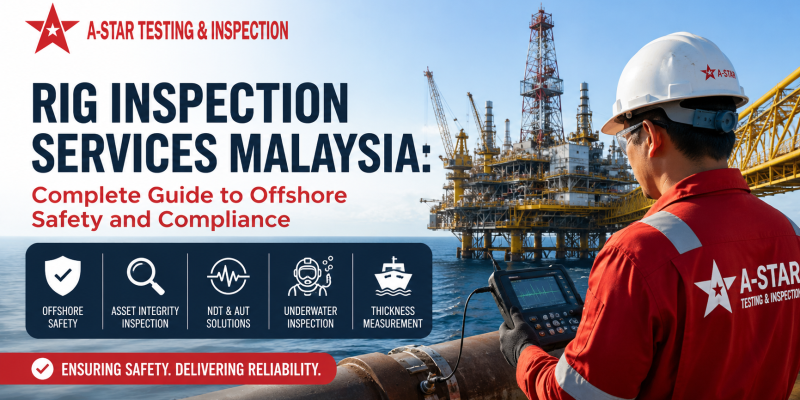
Malaysia’s offshore oil and gas industry is an important source of energy in Southeast Asia. Every day, offshore structures, drilling rigs, marine vessels, and subsea assets are subjected to numerous environmental and mechanical stresses. In these challenging settings, it is critical to ensure structural safety, equipment reliability, and regulatory compliance. That is why it has been important for the rigorous checking by the experts in Rig inspection services Malaysia in the offshore operations.
To avoid failures, enhance operational safety, and minimize costly downtime, modern offshore companies depend on sophisticated inspection techniques, asset integrity programs, and non-destructive testing solutions. As activities increasingly take place beyond the boundaries and tougher regulations are coming into force internationally, inspection services are more important than ever.
What Are Rig Inspection Services?
Rig inspection services are a process of assessing offshore drilling structures, mechanical systems, lifting equipment, pipelines, safety devices, and marine assets to ensure their safety and functionality.
These inspections are used to identify:
- Structural damage
- Corrosion and loss of metal
- Mechanical wear
- Weld defects
- Equipment failures
- Safety compliance gaps
A trusted inspection provider can assist offshore operators in keeping industry standards and mitigating risks in their operations.
Importance of Offshore Rig Inspection
The offshore rigs always encounter the weather, pressure changes, vibrations, humidity, and seawater. Even small faults can cause serious operational and environmental risks if they are not regularly checked.
Key Benefits of Rig Inspection
Improved Offshore Safety
Regular checks can detect any problems that aren’t obvious and turn them into safety risks. An effective Offshore Safety Compliance plan will reduce the risks of equipment failures, structural failures, and offshore accidents.
Reduced Operational Downtime
Unexpected shutdowns can cost a ton of money. Preventive inspections are useful in helping operators identify issues early and plan ahead for repairs.
Regulatory Compliance
International marine regulations, classification society standards, and safety requirements must be adhered to by the offshore operators.
A professional Marine & offshore inspection Company in Malaysia will ensure compliance with standards set by:
- IMO regulations
- IACS guidelines
- ABS and DNV requirements and standards.
- Offshore safety standards
Operational delays and penalties may be incurred if compliance is not achieved.
Types of Offshore Inspection Services
Today’s offshore inspection companies offer a variety of specialized services.
Marine & Offshore Inspection
Comprehensive Marine & Offshore Inspection services involve a thorough examination of marine and offshore vessels, structures, pipelines, and safety systems to ensure their operational reliability.
These inspections cover:
- Structural integrity assessment
- Corrosion monitoring
- Equipment performance evaluation
- Welding inspection
- Safety audits
Rig Equipment Inspection
Offshore equipment is crucial to safe performance and must be regularly checked.
Inspections of rig equipment are routine.
- Lifting Systems and Cranes.
- Pressure vessels
- Drilling equipment
- Safety valves
- Piping systems
- Mechanical components
Professional Rig Equipment Inspection helps to improve the reliability and reduce failures in operation.
Role of Non-Destructive Testing in Offshore Industries
Offshore inspections are based on the use of the highest quality of non-destructive testing (NDT) Malaysia solutions, which help accurately identify defects without damaging or breaking equipment or structures.
Typical NDT procedures in the offshore.
Ultrasonic Testing (UT)
Thickness measurements and corrosion.
Magnetic Particle Testing (MPT)
Locates tiny cracks in the surface of a metal structure.
Radiographic Testing (RT)
Identifies faults in welds and fabrications.
Automated Ultrasonic Test (AUT).
Leading Offshore AUT and NDT Inspection Companies in Malaysia conduct high-precision inspections of pipelines and welds using AUT systems.
NDT technologies help to enhance inspection and reduce disruption.
Underwater Inspection Services for Offshore Structures
Subsea structures are hard to access, and thus special inspection methods are needed.
The professional Underwater inspection services firms in Malaysia use the latest technology, which includes:
- Remotely Operated Vehicles (ROVs)
- Underwater ultrasonic testing
- Diver-assisted inspection
- Digital subsea imaging
Applications of Underwater Inspection
- Offshore platform inspection
- Ship hull examination
- Subsea pipeline monitoring
- Marine foundation assessment
- Port structure inspection
In order to avoid failures and environmental risks due to corrosion, routine inspections are made underwater.
Ship Hull Thickness Measurement and Corrosion Control
Seawater gradually removes the metal from marine structures. Inaccurate Ship hull thickness measurement can lead to the failure to maintain vessel integrity and compliance.
The advantages of thickness measurement are:
- Detects corrosion early
- Improves maintenance planning
- Prevents structural failures
- Helps make dry docking decisions
- Extends vessel lifespan
One of the most reliable techniques for corrosion monitoring in offshore situations is ultrasonic thickness gauging.
Asset Integrity Inspection for Offshore Operations
Preventive maintenance and long-term reliability strategies are now of great concern to offshore operators.
What Is Asset Integrity Inspection?
An asset integrity inspection is the process of assessing offshore assets for safety, reliability, and compliance over their asset life.
Offshore Asset Integrity Management Includes
- Structural inspection
- Corrosion assessment
- Pipeline monitoring
- Risk-based inspection planning
- Mechanical integrity evaluation
Good Offshore Asset Integrity Management avoids downtime and enhances operational performance.
Technologies Transforming Offshore Inspection
Recent technological development is rendering the process of modern offshore inspection quicker, safer, and more precise.
Trending Inspection Technologies Offshore.
- Drone inspection systems
- AI-powered defect analysis
- Real-time corrosion monitoring
- Digital inspection reporting
- Robotic underwater inspection
- Predictive maintenance software
These technologies minimize exposure of humans to dangerous environments and enhance the inspection efficiency.
Frequently Asked Questions (FAQs)
Q1. Why are rig inspection services important?
Ans: Rig inspections can be used to help prevent accidents, minimize downtime, enhance equipment reliability, and help with offshore safety compliance.
Q2. What is the meaning of non-destructive testing when it comes to inspections in offshore areas?
Ans: NDT is a testing technique that is used to find structural defects without harming the equipment or offshore assets.
Q3. What’s the schedule for periodic offshore rig inspections?
Ans: Although the frequency of inspection will vary according to operational conditions, equipment types, and regulatory requirements, regular inspection is important.
Q4. What is the thickness of the ship hull?
Ans: The method of checking the thickness of the hull metal is to ensure the safety of the vessel and to look for corrosion.
Q5. Offshore Asset Integrity Management (OAI) is what?
Ans: It is a proactive approach to maintaining the safety and operational integrity of offshore resources over their life cycle.
Conclusion
With the growth of Malaysia’s offshore business, safety, compliance, and operational efficiency are more important than ever before. Offshore operators benefit from advanced inspection solutions, which enable them to identify and resolve structural challenges early, minimize risks, and enhance long-term asset reliability.
By investing in professional Rig inspection services malaysia, offshore companies can ensure regulatory compliance, enhance safety measures, and avoid expensive failures. Modern inspection services, ranging from underwater inspections to NDT solutions to asset integrity management and equipment evaluations, are an essential part of ensuring offshore operations are safer and more efficient.
Related services in Malaysia
Frequently asked questions
What does a rig inspection cover?
Structural NDT of derrick, substructure and cantilever; drilling equipment (top drive, drawworks, TDS); mud pumps, BOP, riser tensioners; cranes and lifting appliances; and marine systems — all to DNV/ABS/API standards.
Do you perform 5-year rig recertification?
Yes — A-Star Testing Malaysia executes 5-year class recertification for jack-ups and semis, coordinated with class societies and Malaysian regulators.
Which classification societies do you work with?
DNV, ABS, Bureau Veritas, Lloyd’s Register — full third-party inspection support for Malaysian rig owners and operators.
Where do you mobilise rig inspection teams from?
Kuala Lumpur, Kemaman, Miri, Labuan, Kota Kinabalu — covering both Peninsular and East Malaysia offshore operations.